INVITED SPEAKERS
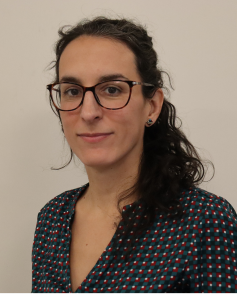
Begoña Abad Mayor
Department of Physics of the University of Basel, Switzerland
Begoña Abad received her PhD in Physics from the Spanish National Research Council (CSIC) in 2016 under the supervision of Prof. Marisol Martín González. Her thesis work focused on the development of thermal property measurement techniques to characterize the efficiency of thermoelectric materials. After graduation, as part of the Kapteyn-Murnane group at JILA within the University of Colorado Boulder (USA), she did work using coherent extreme ultraviolet light to uncover phonon and acoustic dynamics of nanoscale materials. In 2019, she joined the Nanophononics Group at University of Basel (Switzerland) led by Prof. Ilaria Zardo. Shortly after starting in this group, she was awarded a Marie Skłodowska-Curie fellowship, which focused on the implementation and use of time-resolved Raman spectroscopy and transient reflectivity pump-probe techniques to explore electron and phonon dynamics. In 2023, she was awarded a Swiss National Science Foundation PRIMA grant and became a group leader in the University of Basel within the Nanophononics group. Her current research focuses on developing pump-probe time- and frequency-domain techniques to study multi-scale phenomena in complex materials for thermal management and energy harvesting applications.
Speech Title: A toolbox of pump-probe techniques to investigate phonons and thermal transport
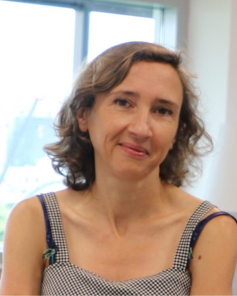
Alexia Auffèves
CNRS MajuLab & Centre for Quantum Technologies, Singapore
Alexia Auffèves is a First Class Research Director (DR1) at CNRS. She runs the CNRS International Research Lab MajuLab.
After an experimental PhD under the supervision of Prof. S. Haroche, she is recruited at CNRS in 2005 in Grenoble where she develops a research line around the theory of quantum optics and quantum thermodynamics. She promotes the physics-philosophy interface within the Grenoble centre for quantum science and technologies now known as QuantAlps, which she runs between 2017 and 2022. In 2022, she launches the Quantum Energy Initiative (QEI), an interdisciplinary and international research community to understand the energetic footprint of emerging quantum technologies.
Her fields of interest are quantum energetics, quantum optics, and quantum foundations.
Speech Title: Thermodynamics of elementary mechanisms of quantum optics
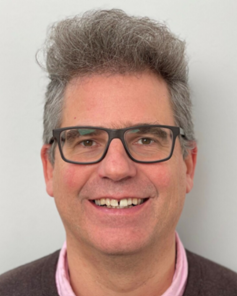
Matias Bargheer
University of Potsdam, Institute of Physics and Astronomy and Helmholtz-Zentrum Berlin (HZB)
Matias Bargheer is professor of physics at the University of Potsdam (UP) and head of the joint research group “Ultrafast Dynamics” at the Helmholtz-Center Berlin for Materials and energy (HZB) since 2009. Since 2024 he is speaker of the collaborative research initiative “Elementary Processes of Light-Driven Reactions at Nanoscale Metals”.
His broad research interests range from plasmon assisted chemistry over nanoscale heat transport and strain waves to ultrafast magnetism and ferroelectricity. These fields are connected by the topic non-equilibrium heat transport at the nanoscale and by the application of ultrafast laser techniques. A unique specialty of his group is ultrafast x-ray diffraction, which is used together with various optical pump-probe spectroscopies and magneto-optics to unravel complex coupling phenomena in condensed matter.
He earned his PhD at the Freie Universität Berlin in 2002. In 2007 he received the Gustav-Hertz Award of the German physical society for his groundbreaking work on the development and application of femtosecond x-ray diffraction. In recent years he has been a guest professor at the Institut Jean Lamour at the Université de Nancy in France. Prof. Bargheer has published more than 130 peer-reviewed articles.
Speech Title: Localizing heat at the nanoscale via dissipation – Testing 3-temperature models by ultrafast x-rays diffraction and transient absorption
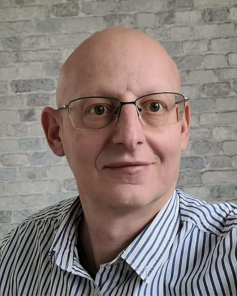
Philippe Ben-Abdallah
Laboratoire Charles Fabry, Institut d’Optique, France
Philippe Ben-Abdallah is a Research Director at the French National Center for Scientific Research (CNRS) and a member of the Laboratoire Charles Fabry at Institut d’Optique in Paris. His research explores radiative heat transfer at the nanoscale, thermoplasmonics, mesoscopic and many-body physics and fluctuational electrodynamics, with applications in thermal management as well as sustainable and renewable energy. He has authored more than 200 scientific publications, including over 150 peer-reviewed articles, book chapters, invited talks and patents. He has made pioneering contributions to the theory of nanoscale radiative heat transfer, introducing key concepts such as many-body thermal radiation and radiative thermal transistor and logic gates. He also discovered novel thermomagnetic effects, including the radiative thermal Hall effect and unveiled fundamental links between heat flux and the momentum of light, opening promising avenues for spin
caloritronics.
Speech Title: Thermal Photonics in Non-Reciprocal Many-Body Systems
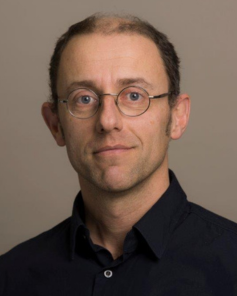
Olivier Bourgeois
Institut NEEL, CNRS, France
Dr. Olivier Bourgeois (OB) is a Research Director of CNRS in Institut NEEL. He is the head of the Micro and nanothermal activities of the TPS group, co-director of the GDR NAME. He obtained his PhD in Condensed Matter Physics from UGA (Grenoble, France) in 1999. He was a post-doctoral fellow in the lab of Prof. Dynes at UCSD California. He has developed a strong expertise in nanothermal physics from very low temperature phonon physics to room temperature materials science for energy and biophysics. With his group and the technical support of Institut NEEL he has developed unique highly sensitive thermometry, experimental set-up for thermal measurement of very thin films (thermal conductivity and specific heat) and innovative heat management at the nanoscale. OB is strongly involved in industrial innovations coming from the results of fundamental science (6 patents). He is co-founder of the MOïZ start-up with D. Tainoff and Thélios with N. Paillet and P. Canac, a start-up dedicated to nanoscale thermal characterization.
Speech Title: Phonon transport in asymmetric nanostructures in the ballistic regime: a search for thermal rectification
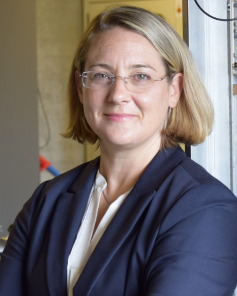
Saskia Fischer
AG Neue Materialien / Novel Materials Group, Institut für Physik Humboldt-Universität zu Berlin
Saskia F. Fischer is a German experimental physicist and professor at the Humboldt-Universitaet zu Berlin since 2010. She is leading the Novel Materials group at the Insitute of Physics and is member of the Center for the Sciences of Materials Berlin and principal investigator in the excellence cluster of the german science foundation “Matters of Activity” at the Humboldt-Universität zu Berlin. She was awarded the Helmholtz Prize for high-precision ‘Nanometrology’ with her team and partners in 2020. Saskia Fischer is known for her research work on novel electronic materials investigating how mathematical principles of symmetry, geometry and topology influence flow of charge, heat and spin. She frames the influence of geometry in material design at the nanoscale as the inverse Bauhaus principle: “Function follows form”. This allows to adapt material parameters such as thermal and thermo/-electrical conductivities for future applications in quantum, nano and power electronics. Beyond her specific discipline, her interests span from foundations of quantum physics to a development of universal interdisciplinary science in order to prepare for current and future global challenges.
https://www.physik.hu-berlin.de/en/gnm-en/neue-materialien
Speech Title: Nanoscale material design for heat transfer phenomena
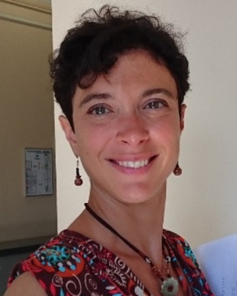
Valentina Giordano
CNRS, Institute of Light and Matter, France
The research activity of VG is focused on the understanding of the microscopic mechanisms ruling thermal transport in functional materials, from disordered to complex crystalline, to nanostructured, based on the investigation of phonon dynamics.
Of Italian origin, VG has completed her studies in physics at the University of L’Aquila, and carried on her PhD in collaboration between the Laboratory for Non Linear Spectroscopy in Florence (IT) and the University Pierre & Marie Curie in Paris (FR). After a postdoc and a position of beamline scientist at the inelastic X ray scattering beamline ID16 of ESRF, in Grenoble, VG was recruited at CNRS in 2011 in the Institute of Light and Matter in Villeurbanne (FR). Here she has integrated the research line on novel materials for thermoelectricity with a special care for the understanding of the microscopic mechanisms ruling thermal transport, which can be investigated by means of phonons dynamics in both crystalline and amorphous systems.
Since 2013 VG has founded and lead a research axis on on thermal transport in novel functional materials, including amorphous materials, complex crystals and nanostructured materials.
Her original strategy consists in coupling the investigation of phonon dynamics in a large spectral range with macroscopic thermal transport measurements for a microscopic understanding of the mechanisms at play. Specifically, in order to address the phonons which are the major heat carriers for a given material, and the ones more expected to be affected by nanostructuration, VG has developed an expertise in a large panel of experimental techniques allowing to access phonon wavelengths from macroscopic (Brillouin Spectroscopy) down to nanometric (transient grating, laser ultrasonics) and sub-nanometric (inelastic x ray and neutron scattering). VG is also the scientific director of the technological platform Transport@ILMTech, which hosts home-made and commercial apparatus for thermal and electronic transport measurements from 2K to 900K. This approach has allowed VG and co-workers to obtain key results, which have changed the common understanding of thermal transport in materials relevant for thermoelectricity, microelectronics and, generally speaking, thermal management.
In the last 10 years, VG has especially focused on the effect of nanostructuration on phonon dynamics and thermal transport, in a combined experimental and theoretical investigation. She has assessed the major role of the elastic contrast, and the importance of the wavelength-lengthscale relation. One key result is the first experimental evidence of the arising of a glass-like phonon dynamics in a nanocomposite with an important elastic contrast, leading to a glass-like thermal transport. More recently, she has started working on periodic nanostructures, and obtained a key result, unveiling the presence of an effect of coherent phonon interference on phonon attenuation.
Speech Title: Phonon transport at the nanoscale: a wave-particle duality matter
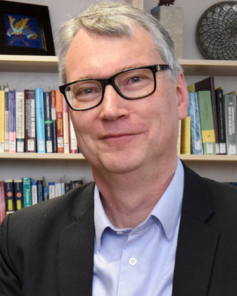
Florian Müller-Plathe
Technical University of Darmstadt, Germany
Florian Müller-Plathe is Professor of Theoretical Physical Chemistry at the Technical University of Darmstadt, Germany. He has used molecular-simulation methods on fluids, polymers and materials for more than 30 years, with major method development in multiscale modelling and coarse-graining, transport properties, and the molecular characterization of interfaces and interphases. After studying chemistry at Ludwig-Maximilian University Munich (D) and obtaining a PhD from the Technical University of Munich (D), he worked in various capacities at Daresbury Laboratory (UK), ETH Zürich (CH), Max-Planck Institute for Polymer Research Mainz (D), Jacobs-University Bremen (D), and Princeton University (USA). He is a member of the Academy of Sciences and Literature Mainz (D).
Speech Title: Heat Transfer at Interfaces: Mechanistic Insights from Molecular Dynamics Simulations